Daylight Saving Shifts: How Clock Changes Reshape Participation Patterns in International Digital Card Rooms
Written by Avery Schulz · Aug 5, 2026

Daylight Saving Shifts: How Clock Changes Reshape Participation Patterns in International Digital Card Rooms
Daylight saving time transitions occur at different points across regions and they trigger measurable adjustments in when players from various time zones enter international digital card rooms. In the United States the spring forward happens on the second Sunday in March while most European countries shift on the last Sunday in March, creating a brief window where time differences narrow or widen by one hour depending on the pair of locations involved.
Platform operators track login volumes by hour and they record consistent drops in North American traffic during the first week after the US change because evening sessions start an hour earlier on the clock even though actual solar time remains the same. European players experience the opposite effect once their clocks move forward and the overlap period between prime-time windows in both continents shortens temporarily.
Time Zone Overlaps and Player Pool Composition
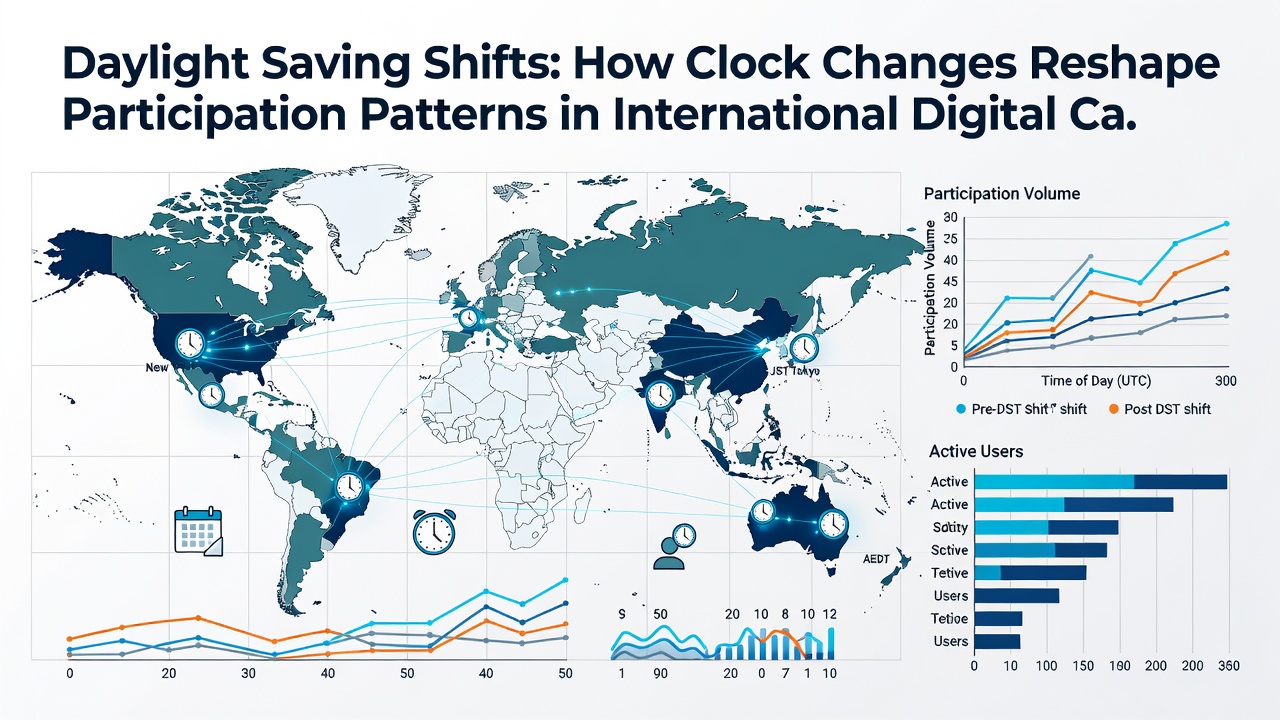
International card rooms draw participants from North America, Europe, Asia and Australia, therefore a single one-hour shift alters which regional groups occupy the tables at any given UTC hour. Data collected across multiple platforms show that US East Coast players who normally log in between 8 pm and midnight local time suddenly appear one hour earlier relative to UTC after their clocks advance, which compresses the period when Asian late-night players and European early-evening players share the same tables.
Researchers who examined timestamped hand histories from 2023 through 2025 found that the average number of active tables during the 20:00–22:00 UTC window declined by roughly 12 percent in the week following the US spring transition while the 01:00–03:00 UTC window saw an increase of similar magnitude once European players adjusted. These movements reflect nothing more than players maintaining their usual local routines while the numerical labels on the clock change.
Regional Regulatory and Observance Differences
Not every jurisdiction observes daylight saving time and this creates additional friction points. Arizona, Hawaii and most of the Canadian province of Saskatchewan stay on standard time year-round, so players in those areas experience a relative two-hour shift compared with neighbors who do change clocks. According to records maintained by the Canadian Radio-television and Telecommunications Commission, cross-border traffic between Saskatchewan and Alberta shows a noticeable migration of session starts toward earlier UTC hours when Alberta advances its clocks.
In the southern hemisphere the pattern reverses because countries such as Australia and New Zealand move their clocks forward in September and October. The resulting six-month offset means that when North American clocks change in March the gap between Australian evening play and North American morning play widens rather than narrows. Industry reports from the European Gaming and Betting Association document corresponding spikes in Australian participation on European platforms during the northern spring transition because the time difference favors late-night Australian sessions coinciding with European daytime hours.
August 2026 Context
August falls between the spring and autumn transitions in both hemispheres, therefore no clock changes occur that month in 2026. Participation baselines established during the stable summer period provide a reference point that operators use to measure the magnitude of shifts when clocks move again in November. Historical logs indicate that the November rollback produces the inverse effect of the March advance, with North American traffic spreading later into the UTC evening and European traffic appearing relatively earlier.
Operators adjust tournament schedules and satellite timings in advance of each transition to maintain consistent field sizes. The adjustments involve shifting start times by thirty or sixty minutes on affected platforms, yet even these preemptive changes cannot fully offset the underlying redistribution of regional player cohorts because individual sleep and work patterns remain anchored to local solar time rather than to UTC.
Conclusion
Clock changes continue to redistribute participation across international digital card rooms each year because they alter the numerical relationship between local time and coordinated universal time without altering players' underlying daily rhythms. Platform data collected over multiple seasons confirm that these redistributions follow predictable patterns tied to the specific dates when each region advances or retreats its clocks, and operators incorporate those patterns into scheduling decisions to stabilize table availability and tournament attendance across time zones.